
Posted on Leave a comment

Showing up is the real superpower

There’s this big myth in music that talent is everything.

It’s not.

I’ve taught naturally gifted musicians, the ones who can hear something once and just play it. No drama. No struggle. And I’ve taught students who’ve had to work for every single chord change.

Do you know what actually makes the difference long term?

Showing up.

Not once. Not when they feel like it. Not just when they’ve had a “good practice week.” Every week.

They turn up when they’re tired. They turn up when school’s been chaos. They turn up when they haven’t practised as much as they should have. They turn up when they feel nervous about playing.

And over time, something happens. They get better.

Not in some big dramatic movie montage way. Just steady. Gradual. Quiet improvement. But that’s the stuff that sticks.


Motivation Is Overrated

People think progress comes from being really motivated.

It doesn’t. Motivation comes and goes. Some days you feel on it. Some days you don’t.

The musicians who move forward aren’t superhuman. They’ve just decided that showing up isn’t optional.

They don’t ask, “Do I feel inspired today?” They just pick up the instrument. That’s it.


Confidence Doesn’t Come First

A lot of students think, “I’ll perform when I feel more confident.”

But confidence doesn’t magically arrive. It’s built.

It’s built by doing the thing. Playing the gig. Singing the high note. Standing up in front of people even when your legs feel a bit shaky.

Every time you do it, it gets easier. Not perfect. Just easier.


Talent vs Showing Up

Here’s the honest truth:

Talent gets you in the door. Showing up keeps you in the game.

I’ll be honest, I was never the best player in the room. But I got the work. I got the gigs, that led to the better gigs, that lead to the steady gigs. I got the trust. How? I showed up. I put in the hours. And I still do.

Talent might get you noticed once. Consistency makes people trust you. Reliability makes people call you back.

One lesson won’t change your life. One rehearsal won’t transform a band. But 100 lessons? Loads of rehearsals? A bunch of live performances under your belt?

That changes who you are. You stop being “someone who plays a bit of guitar.” You become a musician.

And in my experience, the ones who keep turning up, they’re the ones who go the distance. It’s not flashy. But it works.
Posted on Leave a comment

Why Performing Early Changes Everything for Young Musicians

We see it all the time.

A student starts lessons a bit unsure, concentrating hard, still figuring out where their fingers go and whether they sound “right”.

Then they play in front of people.

And everything changes.

Not overnight. Not magically.
But something clicks.

They stop feeling like someone learning music and start feeling like someone who plays music.


It gives lessons a point

When there’s a performance coming up, even a small one, practice suddenly has meaning.

Songs get finished.
Tunings get checked.
Students listen to themselves more carefully.

There’s a goal, and that focus is powerful.


Confidence sneaks up on them

Most students are nervous before their first time on stage.

Then they do it… and realise they survived.

They get a clap.
A smile from mum or dad.
A “well done” from their teacher.

Next week they walk into lessons standing a little taller.


They usually practice more (and argue less)

Funny how that works.

When young musicians want to feel good on stage, they tend to pick up the instrument more at home without being chased.

Motivation replaces persuasion.


They become part of a team

Playing with others or sharing a bill helps students feel they belong to something.

They start encouraging each other, learning from each other, and celebrating each other’s wins.

It’s no longer just a private hobby in a bedroom.


They learn that mistakes aren’t disasters

Wrong notes happen in live music. Everyone makes them.

What students discover is that the world doesn’t end, you keep going, find your place again, and finish strong.

That’s a brilliant life skill.


After one gig…

The most common question we hear is:

“When’s the next one?”

And from that point, progress tends to speed up all by itself.


How we see it at MD Music

We treat performing as a natural part of learning, not something scary that appears years down the line.

From relaxed studio sharings to bigger events, students are supported, prepared and encouraged every step of the way.

For many of them, it’s the moment they truly start believing they’re musicians.


If you’d like your child to grow in confidence as well as ability, come and see what we do.

👉 Visit our contact page and join the mailing list to keep up with concerts, opportunities and news.

Posted on Leave a comment

AI in Music: Tool, Threat, or Wake-Up Call?

A musician and music teacher’s perspective

Artificial intelligence is now writing songs, generating lyrics, producing tracks, and mimicking the sound of real artists in seconds. For some, AI in music feels exciting. For others, it feels like a genuine threat.

As a songwriter, performer, and music educator with over twenty years of experience, I sit right in the middle of this conversation. That is where it belongs.

The reality of AI in music is far more nuanced than the headlines suggest.


What AI Is Good At in Music

AI excels at recognising patterns. When trained on large amounts of data, it can:

• Generate chord progressions
• Suggest melodies and harmonies
• Mimic musical genres and styles
• Create background or functional music
• Offer songwriting prompts and practice tools

For hobbyists, content creators, and musicians looking for inspiration or efficiency, AI can be useful. I use it myself in supportive ways.

But this is where the conversation needs balance.


What AI Cannot Replace

AI cannot:

• Feel emotion
• Experience growth or failure
• Perform live
• React to other musicians in real time
• Build confidence in a nervous student
• Connect with an audience in a room

Some of the most powerful music ever written came from imperfection, not optimisation. AI can imitate style, but it cannot create meaning.

Music is not just sound. It is lived experience, emotion, and human connection.


AI, Royalties, and the Value of Music

Music has always worked on a simple principle.
If you create it, you are rewarded for it.

AI complicates this model.

Important questions remain unanswered:

• Who owns AI generated music
• Who earns royalties from it
• What happens when AI is trained on human music without consent or payment

If musicians’ work is used to train systems that replace them without permission or compensation, that is not innovation. It is extraction.

Without fair reward, musicians lose the ability to build sustainable careers, invest in their craft, and pass skills on to the next generation.


The Real Risk of AI in Music

The greatest risk is not that AI will write better songs.

It is that original human music becomes devalued.

When music becomes something that can be generated instantly, we risk:

• Discouraging young people from learning instruments
• Undermining years of training and discipline
• Replacing lived experience with convenience

Once value is lost, it is extremely difficult to restore.


Why Music Education Matters More Than Ever

At MD Music, we do not just teach notes and chords.

We teach:

• Discipline
• Confidence
• Listening skills
• Collaboration
• Emotional expression
• Creative problem solving

These are deeply human skills. No algorithm can replicate them.

In a world increasingly shaped by artificial intelligence, real musicianship becomes more valuable, not less.


My Position on AI in Music

AI is not the enemy.
But it should not be the artist.

Used responsibly, AI can support musicians with learning, organisation, ideas, and efficiency. It should never replace the human voice, the human story, or fair reward.

Music at its best is human, flawed, emotional, and alive.

That is worth protecting.

Mike Donaghy
MD Music

Posted on Leave a comment

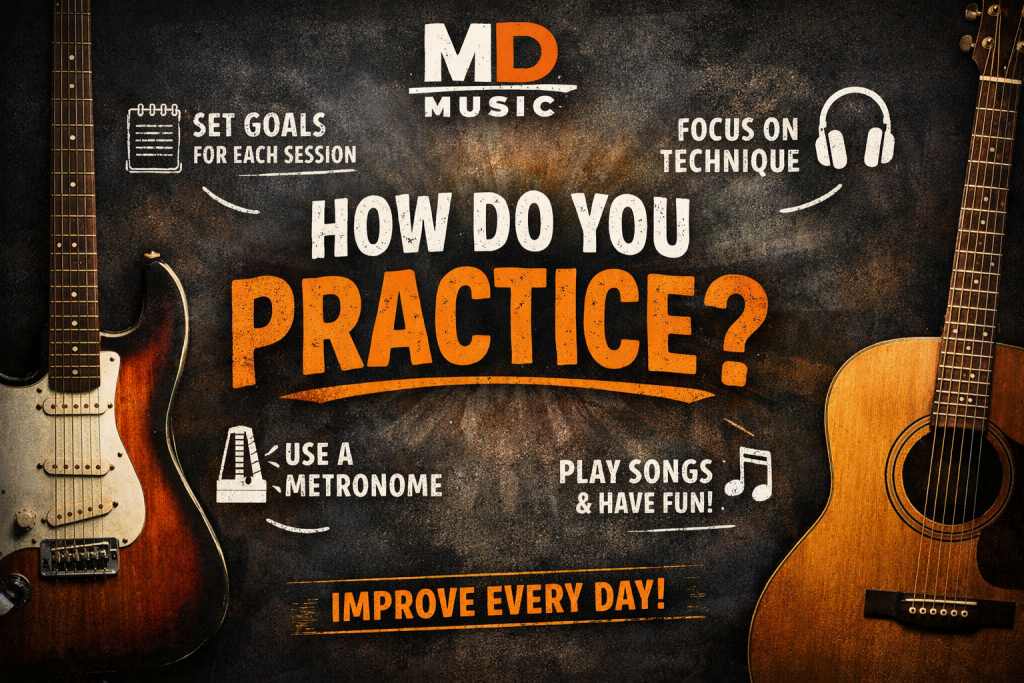
How do you actually practice

How Often Should a Guitar Student Practice?

A Music Teacher’s Honest Answer

One of the most common questions I get from parents and students is:

“How often should I be practising?”

It’s a fair question — and the honest answer might surprise you.

It’s not about hours. It’s about consistency.

In my experience as a teacher, progress doesn’t come from one long practice session a week.

It comes from short, regular, focused practice.

For most beginner guitarists:

  • 10–15 minutes a day is far more effective than 1–2 hours once a week

Daily contact with the instrument builds muscle memory, confidence, and familiarity. Even on busy days, a short practice keeps momentum going.


What should practice actually look like?

Good practice doesn’t mean playing random songs from start to finish. A simple structure works best:

  1. Warm-up (2–3 minutes)Finger exercises or chord changes to get the hands moving.
  2. Core skill (5–7 minutes)This could be:
    • A new chord
    • A rhythm pattern
    • A short section of a song
  3. Something enjoyable (5 minutes)Playing a song they like, even if it’s not perfect yet.

That balance keeps practice productive and enjoyable.


For parents: encouragement beats pressure

Progress in music isn’t always linear. Some weeks fly, others feel slow — that’s normal.

What helps most is:

  • Encouragement, not nagging
  • Routine, not pressure
  • Praising effort, not just results

A calm “Have you had a few minutes with your guitar today?” works far better than turning practice into a battle.


Why regular practice matters in music education

Learning an instrument teaches far more than notes and chords. It helps develop:

  • Concentration
  • Discipline
  • Confidence
  • Resilience when things don’t come easily

These skills carry over into school, work, and life well beyond music.


Final thought

If there’s one thing I’d want every student to remember, it’s this:

Little and often beats lots and rarely.

A guitar sitting in its case all week doesn’t help anyone — but ten focused minutes a day absolutely can.

If you’d like guidance on building good practice habits or choosing the right starting point, feel free to get in touch. Supporting students at every stage is what we do.